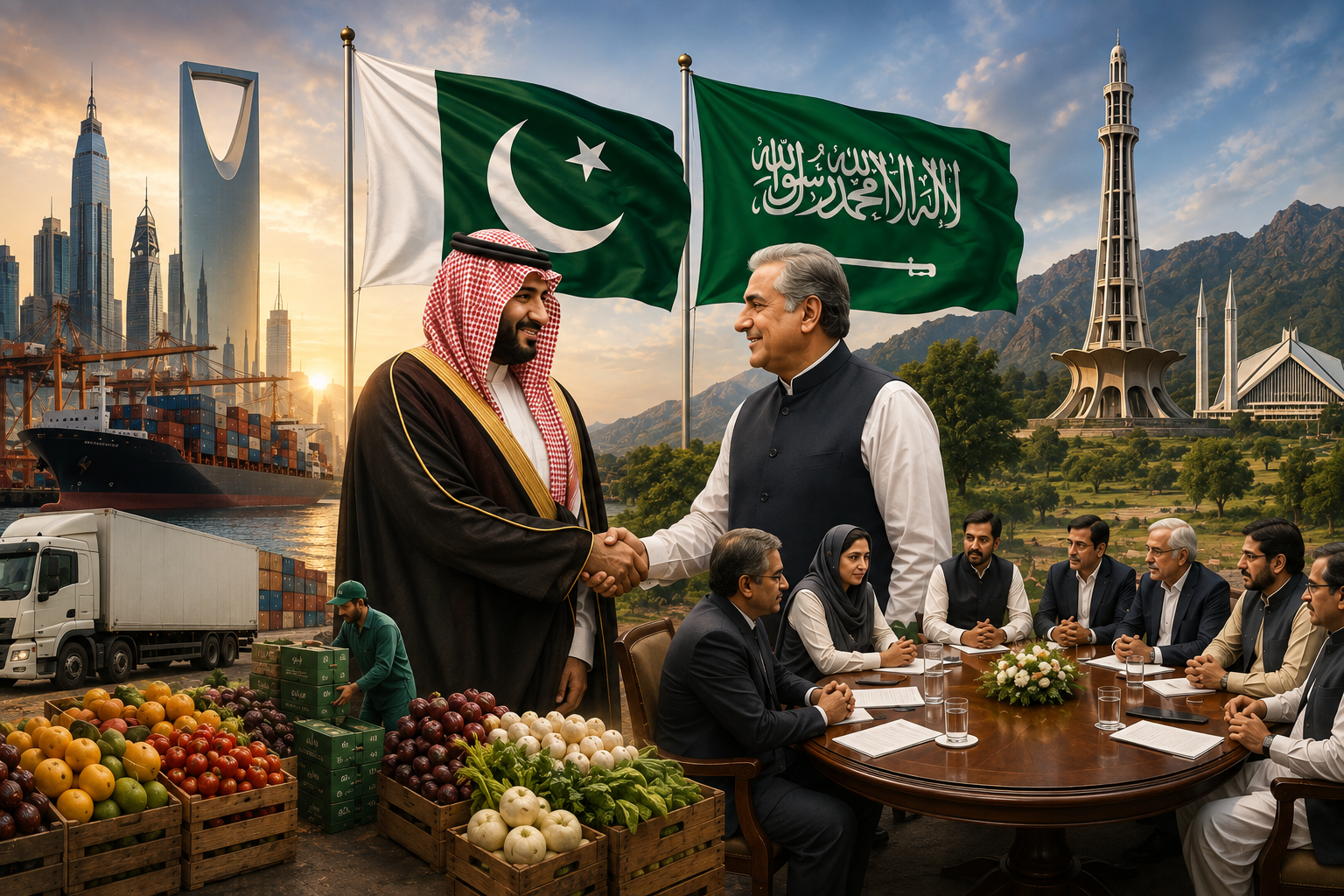
A Critical Dual Crossroads
As Pakistan navigates a pivotal phase in
its external diplomacy and internal governance, two major developments
highlight the path forward: the expansion of high-value agricultural and trade
cooperation with the Kingdom of Saudi Arabia, and an increasingly urgent
domestic need for structural political reconciliation.
1. Pakistan-Saudi Arabia Agri-Food Cooperation
Economic collaboration between Islamabad
and Riyadh has gained significant momentum following high-level bilateral
reviews led by the Ministry of Economic Affairs:
·
Upcoming High-Level Visit:
Saudi Minister for Environment, Water, and Agriculture, Abdulrahman Al-Fadhli,
is scheduled to visit Pakistan to finalize joint investment frameworks and
explore collaborative ventures.
·
Four Priority Export Sectors:
Bilateral working groups have identified four primary agricultural segments to
drive Pakistan's exports to Saudi Arabia:
·
Meat & Livestock
·
Rice
·
Processed Foods
·
Animal Fodder
·
Research and Innovation: The
visiting delegation is slated to inspect agricultural innovation hubs,
including the National Agricultural Research Centre (NARC), while advancing
plans for a dedicated Pakistan-Saudi Agri Investment Fund.
·
Diplomatic Coordination:
Parallel to economic initiatives, diplomatic engagements including discussions
between Deputy Prime Minister Ishaq Dar and regional counterparts reaffirm
shared commitments toward regional stability, Middle Eastern peace, and mutual
strategic support.
2. The Imperative For A Broader Political Dialogue

On the domestic front, the Supreme Court’s
intervention regarding medical relief and hospital transfer for PTI founder
Imran Khan has once again brought the necessity of national political
engagement to the forefront.
[ Judicial / Relief Measures] ──► [ Institutional Reconciliation] ──► [ Broad-Based Political Stability]
·
Beyond Short-Term Relief: While
judicial decisions provide necessary legal and humanitarian clarity, lasting
stability cannot be achieved through piecemeal interventions alone.
·
Constitutional Consensus &
Federal Structure: Key national questions including the 18th Constitutional
Amendment, the National Finance Commission (NFC) Award, and the creation of new
administrative units require broad-based parliamentary consensus rather than
unilateral top-down moves.
·
Empowering Local Governance:
Genuine administrative efficiency demands that political power and financial
resources are devolved to grassroots local governments rather than remaining
centralized within federal or provincial capitals.
3. Balancing Institutional Boundaries For Economic Progress
·
Economic Stakes: Pakistan faces
complex fiscal, energy, and structural challenges that cannot be resolved in an
environment of perpetual political confrontation.
·
Respecting Constitutional
Limits: Sustainable reconciliation requires all major political entities and
state institutions to operate strictly within their defined constitutional
limits, replacing animosity with constructive engagement.
Conclusion
Unlocking Pakistan’s economic potential
through strategic international partnerships like the Pak-Saudi agricultural
corridor requires durable domestic stability. Embracing an open, inclusive
political dialogue and adhering to constitutional norms remain the most
dependable foundation for national progress and public welfare.