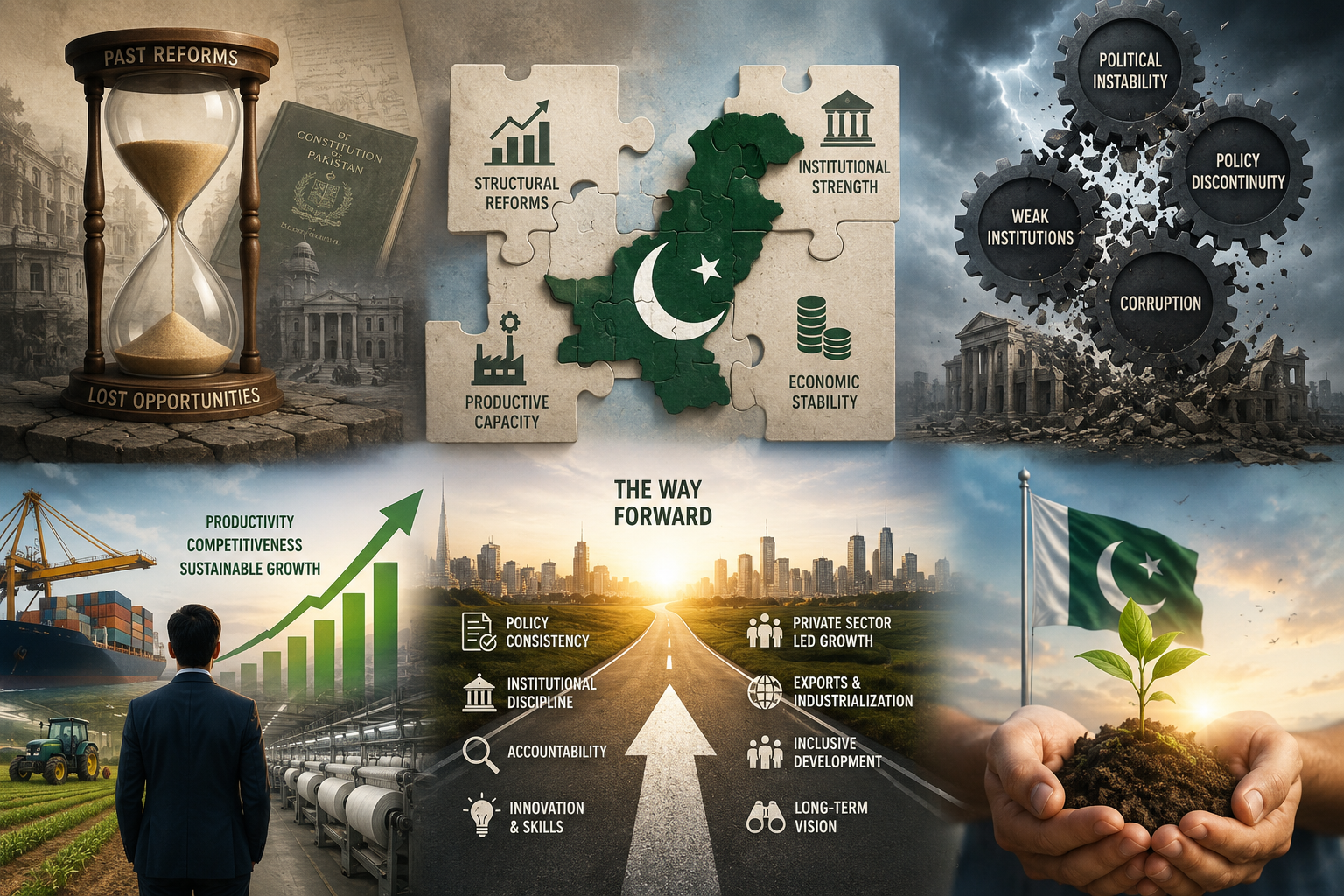
The Puzzle of Impermanence in Pakistan's Economic History
Throughout its history, Pakistan has
undertaken genuine structural reforms under various administrations. Productive
capacities were built, foundational constitutional frameworks established, and
public institutions modernized to levels that once earned regional admiration.
Yet, almost none of these achievements proved permanent.
The decisive question confronting
policymakers today is not whether reforms took place, but why their benefits
consistently eroded after political transitions. As Zafar Masud highlights in
[Dawn's Economic Analysis] (https://www.dawn.com/news/2024274/escaping-the-past),
breaking this cycle requires shifting from temporary, personality-driven
stabilizations to institutionalizing productivity gains and household welfare.
Root Causes Of Reform Fragility
[ Personality-Driven Authority] ──► [
Lack of Statutory Autonomy & Grassroots Ownership] ──► [ Reversal on Political Transition]
·
Personalized Legitimacy: Past
reform agendas derived authority from individual political patrons rather than
binding national compacts. When those figures exited office, the authority
backing the reforms vanished.
·
Revocable Delegations to Technocrats:
Empowering expert technocrats remained a temporary political courtesy rather
than an entrenched statutory grant. As political priorities shifted, autonomous
decision-making was quickly rescinded.
·
Absence of Grassroots Ownership:
Reforms were largely executed as top-down elite projects without building an
active constituency among the public, leaving policies vulnerable to public
backlash.
· Capital Accumulation vs. Total Factor Productivity: Economic growth relied on external borrowing and capital injections rather than boosting the productivity of labour, land, and energy. Over the past 25 years, productivity's contribution to Pakistan's economic expansion has been nearly zero.
Global Lessons: Discipline Over Discretion
Economies that transitioned out of similar economic vulnerabilities pursued structural transformation:
·
South Korea: Subjected domestic
industries to the competitive discipline of global export markets rather than
perpetual domestic subsidies.
·
Vietnam: Stabilized
macroeconomic fundamentals and utilized foreign direct investment (FDI) to
import organizational capabilities, technical standards, and supply-chain
discipline.
The Five Necessary Strategic Inversions
1.
Strategic Dimension | Past
Discretionary Approach | Necessary Institutional Inversion | Legitimacy Source
2.
Vested in political
personalities and discretionary patronage | Anchored in a multi-party Charter
of Economy and societal consensus | Policy Formulation
3.
Top-down technocratic
blueprints without public input | Expert design paired with local delivery and
grassroots ownership
4.
Regulatory Authority |
Temporary autonomy granted by executive convenience | Irrevocable statutory
autonomy (replicating central bank independence) | Measurement Criteria
5.
Aggregate headline GDP figures
masking household realities | Welfare-adjusted GDP measuring real disposable
income and poor-specific inflation
Implementation: Conversion Over Creation
Rather than creating redundant parallel
authorities that perish with their creators, practical reform requires
converting existing constitutional bodies into binding rule-based engines:
·
Council of Common Interests
(CCI): Mandate quarterly statutory economic reviews to harmonize federal and
provincial tax bases, energy pricing, and human capital investments.
·
State-Owned Enterprise (SOE) Governance:
Enforce enterprise governance laws strictly through binding legal frameworks to
eliminate discretionary operational
·
Plugging Fiscal Leakages:
Redirect capital away from informal cash hoards and fiscal deficits back into
the formal banking system to fuel productive private-sector enterprise.
·
Ahead-of-Deadline Legislation: Hard-code external benchmark commitments and
administrative reforms into statute well ahead of review deadlines to prevent
policy reversals.
Conclusion
Past reform efforts had political authority but lacked a lasting purpose. The imperative now is to anchor policy around a clear purpose raising national productivity in the service of household welfare supported by an institutional architecture designed to outlive its architects. Converting executive discretion into durable institutional rules provides the single most reliable safeguard against returning to familiar cycles of economic crisis.