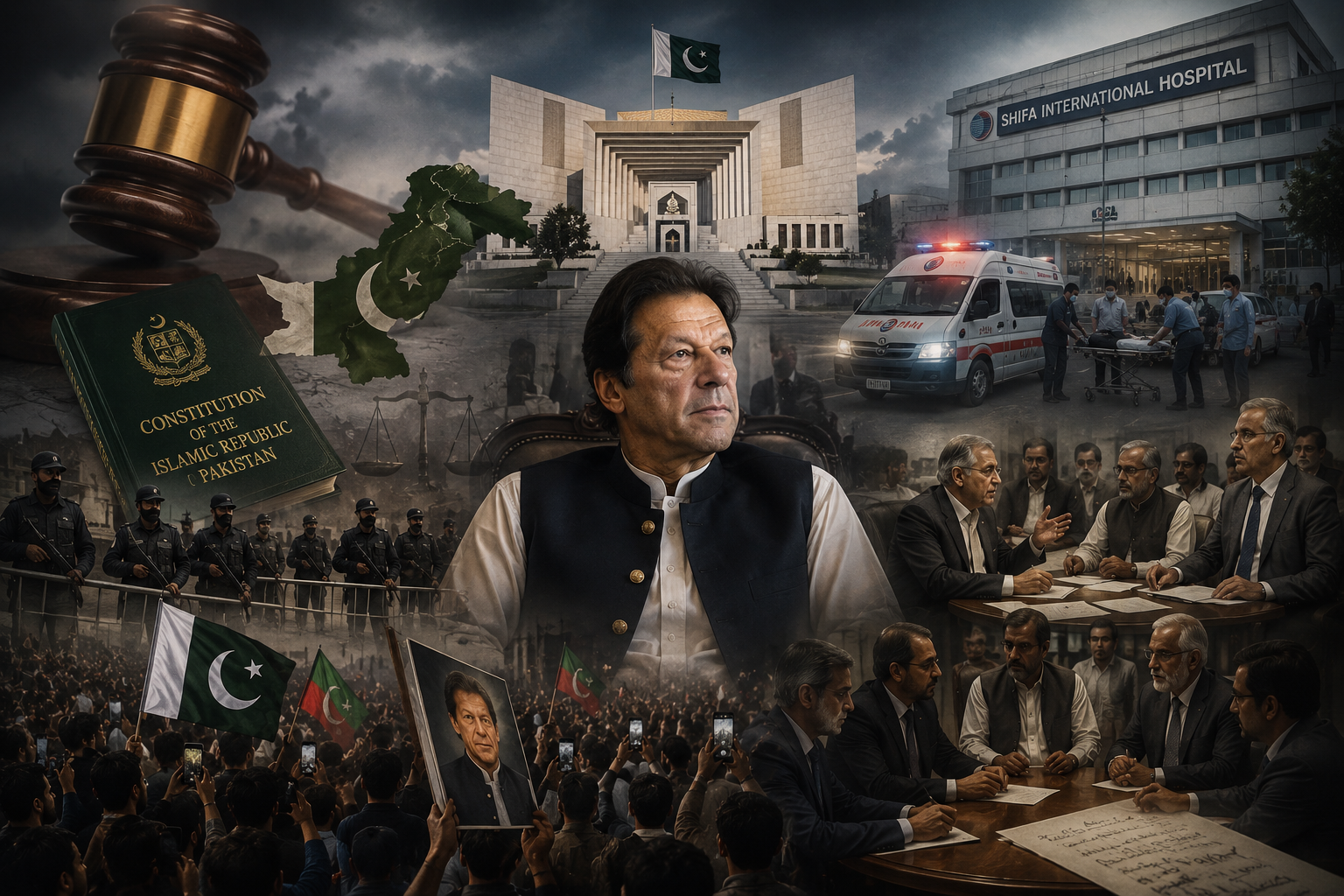
The Ripple Effects of a Judicial Order
The Supreme Court of Pakistan’s directive
ordering the transfer of incarcerated former Prime Minister Imran Khan to
Islamabad’s Shifa International Hospital for comprehensive medical care has
triggered widespread political debate. Beyond the immediate humanitarian and
medical context, the ruling has led political analysts, insiders, and observers
across the country to examine the deeper institutional motives, backchannel
dynamics, and emerging possibilities driving this moment.
The Five Working Scenarios
1. Leverage for the 28th Constitutional
Amendment
The first theory views the judicial relief
as a calculated political instrument designed to exert pressure on the ruling
coalition. Under this view:
·
The relief granted to the
Pakistan Tehreek-e-Insaf (PTI) founder acts as leverage to compel key coalition
partners primarily the PML-N and PPP to align on proposed constitutional
changes, including the prospective 28th Constitutional Amendment.
·
Once institutional or
legislative objectives are achieved, the pressure dynamics could shift once
again.
2. Establishment Fatigue and Unbroken
Popularity
The second scenario posits a fundamental
strategic reassessment within key power centres:
·
After years of economic
volatility and administrative gridlock, the incumbent political setup has
struggled to deliver sustained stability.
·
Concurrently, despite
relentless legal battles, defections, narrative crackdowns, and over three
years of imprisonment, Imran Khan’s political core and public popularity have
remained intact.
·
In this analysis,
decision-makers are coming to the realization that political and economic
stability cannot be engineered while sidelining the country’s most prominent
political reality.
3. Internal Institutional Realignment:
Echoes of 1988 and 2007
The third perspective draws historical
parallels from Pakistan’s complex constitutional past:
·
Similar to the structural
corrections that emerged after the dissolution of the Junejo assemblies in the
late 1980s, or the institutional course-correction during the 2007 Lawyers'
Movement, this view suggests an internal institutional desire to restore credibility
and institutional prestige.
·
The core premise here is that
individual political agendas must yield to the long-term integrity, rule of
law, and standing of key state institutions.
4. The International Dimension and US
Politics
The fourth interpretation connects domestic
developments to international diplomatic considerations:
·
Growing advocacy by the
Pakistani diaspora and international human rights bodies continues to keep the
treatment of incarcerated political figures on the global radar.
·
With heightened diplomatic
sensitivities and shifting international alignments, key decision-makers may be
seeking to avoid unnecessary international friction by adhering to recognized
legal and humanitarian norms.
5. The Geopolitical Deep-State Thesis
The fifth and most speculative analysis
looks through the lens of long-standing geopolitical and intelligence
interests:
·
Proponents of this view argue
that international stakeholders and regional security observers increasingly
view prolonged political instability in Pakistan as counterproductive to
broader regional security and economic corridors.
·
Consequently, a strategic
signal is being sent that persistent political confrontation must give way to a
workable political consensus.
The Central Reality: Five Scenarios, One Victor
While observers may debate which of these
five scenarios holds the most weight, they all converge on a singular reality:
Imran Khan remains the undeniable centre of gravity in Pakistani politics.
[ Five Working Scenarios]
┌──────────────────────────────────────────────────────────────┐
│ │ │ │ │
1. 28th Amendment 2. Popularity & 3. Institutional 4. Diaspora & 5. Geopolitical
Pressure Tactic Governance
Deficits Realignment Global Politics Realities
└──────────────────────────────────────────────────────────────┘
│
▼
[ The
Inescapable Reality]
Imran Khan Remains the Pivot of National Politics
Over the past three years, the former prime
minister has endured an unprecedented series of challenges:
·
Ouster from office through
coordinated political maneuvering.
·
Widespread character
assassination campaigns and endless legal cases ranging from Toshakhana to the
cipher and beyond.
·
A direct assassination attempt,
the events of May 9, and the dismantling of his party structure.
·
Prolonged solitary confinement
in Adiala Jail.
Despite these hurdles, he has refused to compromise on his core narrative or seek personal relief through political concessions.
An Enduring Legacy of Resistance
Whether this hospital transfer leads to
renewed incarceration, extended medical care, or eventual political
rehabilitation, the political equation has fundamentally altered. In the public
consciousness and the pages of political history, uncompromising resilience in
the face of immense adversity cements an enduring legacy one that confirms that
long-term stability in Pakistan cannot be achieved without addressing genuine
public representation and the rule of law.