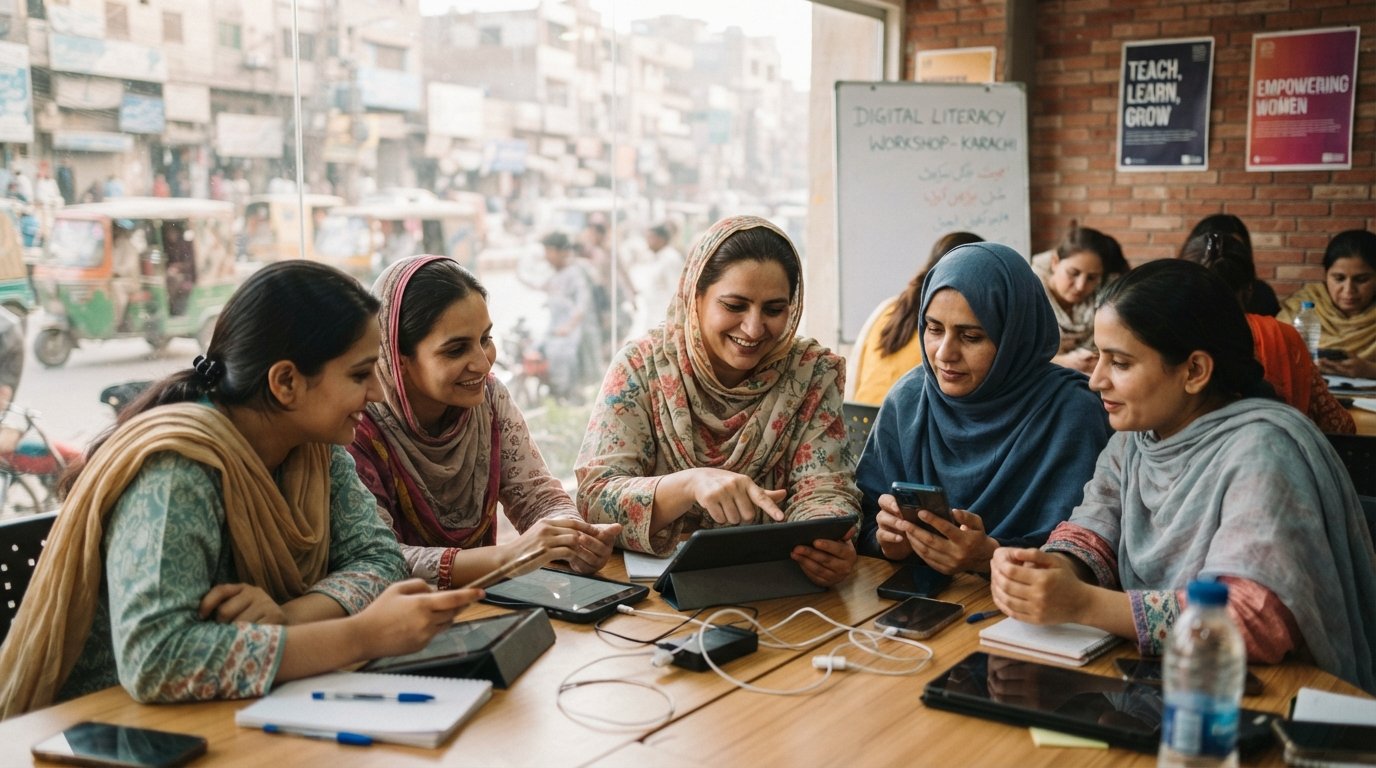
A Historic Shift in Connectivity and Account Ownership
Pakistan has recorded the largest reduction in mobile phone ownership and mobile internet gender gaps among countries surveyed in recent global assessments. Because connectivity mediates access to healthcare information, education, credit, and market ecosystems, narrowing this divide is both an intrinsic milestone and an engine for women's economic participation.
Targeted social protection initiatives, improved national identity documentation (CNIC), and deliberate outreach by financial institutions have transformed the formal landscape. A decade ago, only about one in ten Pakistani women held a formal financial account; today, estimates indicate that roughly **half of adult women have a financial account registered in their name.
However, a fundamental question remains: does formal access equates to actual financial control and autonomy?
The Evolution Of Pakistan's Fintech Ecosystem
Pakistan’s digital financial architecture has expanded steadily over the last three decades to replace cash-heavy transactions:
1.
Late 1990s: Introduction of
preliminary online banking systems.
2.
2009: Launch of branchless
mobile money ecosystems.
3.
2021: Introduction of the State
Bank of Pakistan’s (SBP) instant payment platform,
4. Raast: driving real-time interoperability and low-cost transfers.
The Critical Gap: Access Versus Decision-Making Control
While quantitative metrics for account ownership are rising, economic research consistently distinguishes between having a registered account and exercising meaningful decision-making authority over those funds:
[ Formal Account Registration] [ Genuine Financial Autonomy]
•
Name on a digital wallet • Ability to decide spending
•
Government welfare recipient • Freedom from household coercion
• Intermediary-dependent • Independent financial planning
Intra-Household Dynamics:
In practice, women rarely exercise
exclusive control over monetary assets registered in their names. At best, they
participate in household spending decisions; frequently, they are bypassed
entirely.
Informal Strategies vs. Digital Visibility:
In traditional cash settings, women
protected savings using informal mechanisms—such as rotating savings groups
(*committees*), entrusting funds to trusted older female relatives, or keeping
micro-enterprises small and invisible.
Digital Vulnerabilities:
Shared family smartphones and household suspicion around passwords or privacy settings make it difficult for women to protect digital balances from domestic appropriation.
The Cash-Out Dilemma In Social Protection
The migration of large-scale social welfare disbursements to direct mobile wallets illustrates the gap between digital delivery and daily cash reality:
The Cash-Dominant Environment:
Because local retail environments in
low-income neighbourhood’s remain cash-based, female beneficiaries must
immediately convert digital disbursements into physical paper currency.
Agent Extraction and Leakage:
Cashing out at local retail agents’ re-exposes women to informal deductions, agent fees, and exploitation—the exact intermediaries digital transfers aimed to eliminate.
Policy Roadmap: Designing Fintech For Women Lived Realities
To ensure fintech delivers substantive economic agency rather than surface-level account registration, financial regulators and fintech providers must implement structural reforms:
1. Interoperable Merchant QR Infrastructure
Accelerating low-cost, interoperable QR-code payment acceptance at the micro-retail and grocery level reduces the necessity of immediate cash-outs, keeping money within a secure digital circuit.
2. Privacy-Centric Interface Design
Fintech apps must be built acknowledging the reality of shared household devices and low digital literacy. Features like discrete balance displays, simplified multi-language audio interfaces, and enhanced security protections help protect user privacy.
3. Goal-Oriented Savings Products
Most low-income women structure financial goals around concrete life milestones rather than generic interest-bearing accounts. Structuring products around tangible targets—such as assembling a wedding fund, home improvements, livestock purchases, or school fees—dramatically increases sustained adoption and retention.
4. Strict Enforcement at Cash-Out Points
As long as the cash economy persists, regulatory authorities must actively monitor and penalize predatory fee deductions by local cash-out agents and retailers.
5. Moving from Ownership to Empowerment
Expanding mobile connectivity and financial
account registration provides a vital baseline for inclusion. Yet without
deliberate policies addressing user privacy, cash dependency, and products
tailored to women's daily economic priorities, fintech will remain a formal
exercise rather than a transformative tool for female autonomy.